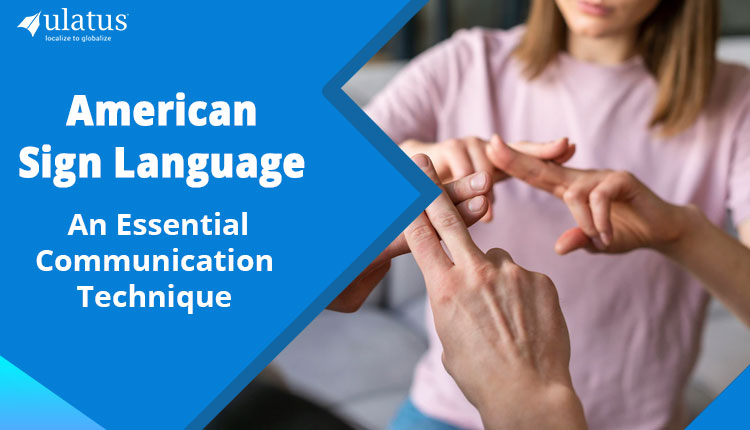
American Sign Language (ASL) is a complete, natural language that uses handshapes, movement, facial expressions, and body posture instead of spoken or written words. It is the primary language of the Deaf community in the United States and English-speaking Canada, with its own grammar, syntax, and vocabulary entirely distinct from English.
Here’s the part most explainers skip. Picture a Deaf patient in an emergency room, handed a notepad and pen while a doctor explains a medication schedule. Technically, the hospital communicated something, but whether the patient understood the dosage is a different question. One number that gets repeated often, though it traces back to secondary sources, puts nationally certified ASL interpreters at around 10,000. And that’s the problem: qualified interpretation is thinnest where the stakes are highest.
ASL isn’t a gestural code for English, and it isn’t universal. It’s a full linguistic system in its own right, every bit as legitimate as French or Mandarin, just conveyed visually instead of acoustically. The National Association of the Deaf (NAD) frames being Deaf as a linguistic and cultural identity built around ASL, not simply a medical condition. Estimates put the number of people using ASL as a primary language in the U.S. between 250,000 and 1 million, though no government census tracks the number precisely.
The History of ASL: From Martha’s Vineyard to a Recognized Language
ASL didn’t appear overnight. It was shaped, gradually, by the communities that needed it.
Early roots: French Sign Language and Martha’s Vineyard Sign Language
Long before ASL had a name, isolated Deaf communities were already signing among themselves. On Martha’s Vineyard, an unusually high rate of hereditary deafness meant hearing and Deaf islanders alike used a local sign language as a matter of course. That tradition, along with home sign systems in Deaf households nationwide, fed into what became ASL.
Gallaudet, Clerc, and the American School for the Deaf (1817)
The pivotal moment came in 1817, when Thomas Hopkins Gallaudet and Laurent Clerc founded the Connecticut Asylum for the Education and Instruction of Deaf and Dumb Persons in Hartford (later renamed the American School for the Deaf). Clerc, a Deaf teacher fluent in French Sign Language, taught Gallaudet his language during their 55-day voyage back from France. The school opened with seven students, including Alice Cogswell, and it became the meeting point where French Sign Language, Martha’s Vineyard Sign Language, and home sign blended into modern ASL.
1960: William Stokoe proves ASL is a real language, not “broken English”
For decades, hearing educators dismissed ASL as a crude imitation of English. That changed in 1960, when linguist William Stokoe published *Sign Language Structure*, the first rigorous linguistic analysis of a signed language. Using what’s now called Stokoe notation, he showed that ASL signs have internal structure comparable to the phonemes of spoken language, proof of a full, autonomous language with its own rules. His 1965 dictionary built on the same premise, and his work launched modern sign language linguistics.
How ASL Grammar and Structure Actually Work
If ASL isn’t English on the hands, what is its grammar doing?
TIME + TOPIC + COMMENT sentence order
ASL commonly organizes sentences using what’s called a Time-Topic-Comment structure. A signer establishes when something happened (YESTERDAY, NEXT-WEEK), then introduces the topic, then adds the comment about it. Because ASL verbs aren’t conjugated for tense, that opening time marker does the work English handles with endings like “-ed” or “will.” Word order stays flexible and shifts with context and emphasis, much as ASL grammar more broadly resists any fixed template.
Facial expression and body posture as grammar, not decoration
Raised eyebrows, a tilted head, a scrunched nose: in ASL none of that is decoration layered on the “real” language. It is the grammar. Non-manual markers signal yes/no questions, wh-questions, conditionals, and topicalization, so identical handshapes carry different grammatical meaning depending on what the face and body do at the same time. Miss the eyebrow movement, and you can miss whether a sentence is a statement or a question.
Classifiers and space: how ASL shows relationships without words
ASL also uses classifiers, handshapes that stand in for categories of objects or people, positioned in the space in front of the signer to show spatial relationships. Instead of saying “the car is behind the tree,” a signer places a “car” classifier behind a “tree” classifier in signing space, and the relationship is immediately visible. That spatial grammar is one reason ASL work demands genuine fluency rather than word-for-word substitution, the same principle governing quality in any form of language translation.
ASL Is Not Universal: How It Differs From Other Sign Languages
A persistent myth holds that Deaf people worldwide share one universal sign language. They don’t.
Why ASL and British Sign Language are mutually unintelligible
Despite both countries speaking English, American Sign Language and British Sign Language are mutually unintelligible. ASL traces its roots back to French Sign Language through Laurent Clerc’s influence at the American School for the Deaf. BSL developed independently in Britain and uses a two-handed manual alphabet (compared to ASL’s one-handed alphabet), along with distinct grammar and vocabulary.
How many sign languages exist worldwide
Linguists estimate more than 300 distinct sign languages are in active use worldwide, though nobody knows the exact number with confidence, since new sign languages keep emerging within Deaf communities. Each one has its own grammar, vocabulary, and regional dialects, shaped by the community that created it, just as spoken languages evolved independently across regions.
Who Uses ASL: Deaf Community, Culture, and Everyday Life
Understanding who uses ASL means understanding a community, not just a communication method.
Current U.S. Deaf and hard-of-hearing population using ASL
An estimated 37.5 million American adults, roughly 15% of adults, report some trouble hearing, according to CDC National Health Interview Survey data published in 2024, and separately, about 1 million people over age five are considered functionally deaf. Within that broader group, commonly cited estimates suggest 500,000 to 1 million people identify as culturally Deaf, using ASL and holding a Deaf cultural identity rather than a medical one. These remain directional estimates; no census tracks ASL use specifically.
Deaf culture as identity, not just disability
The NAD describes Deaf identity as linguistic and cultural, positioning the Deaf community as a distinct cultural and linguistic minority with its own history, traditions, humor, and social norms centered on ASL. That framing doesn’t replace disability civil rights protections, it coexists with them: Deaf Americans still rely on the ADA to secure equal access, even as they identify culturally as Deaf first.
Certified ASL Interpreters: Skills, Certification, and What Qualifies Someone
Fluency in ASL and qualification to interpret professionally are not the same thing, and the gap between them matters more than most people realize.
Simultaneous vs. consecutive interpretation
Interpreters generally work in one of two modes. Simultaneous interpretation happens in near-real time, with the interpreter signing as the speaker talks, standard for live meetings, classes, and broadcasts. Consecutive interpretation involves the speaker pausing so the interpreter can render a complete thought, common in legal depositions or sensitive settings where precision matters more than pace.
RID and NIC certification standards
The Registry of Interpreters for the Deaf (RID), through its testing partner CASLI, administers the National Interpreter Certification (NIC). Candidates need a bachelor’s degree or an approved alternative pathway, then must pass a written Generalist Knowledge Exam and a Performance/Interview Exam that tests real-world skill and adherence to the RID Code of Professional Conduct. Certification runs on four-year cycles, and maintaining it requires 8.0 continuing education units plus active RID membership. Dedicated ASL interpretation services typically require this exact credential before an interpreter is placed on assignment.
The interpreter shortage is real, but the numbers behind it deserve care. The figure quoted most often, roughly 10,000 certified interpreters against an estimated 500,000 ASL users, comes from secondary sources citing RID’s public registry rather than an official RID count. Treat it as an illustration of scarcity, not a census. If you need a current number, search RID’s live member directory.
Why “conversational ASL” is not the same as professional interpretation
Knowing enough ASL to chat with a Deaf coworker doesn’t qualify anyone to interpret a medical diagnosis or a courtroom proceeding. Professional interpretation demands split-second accuracy, cultural fluency, subject-matter vocabulary, and strict ethical neutrality, none of which casual fluency guarantees. The same gap runs through translation work generally: speaking a language and rendering it accurately under pressure are different skills.
Choosing the Right Language Access Solution: American Sign Language Interpretation, Captioning, or Multilingual Translation
This is where most guides stop short.
When the law requires a qualified ASL interpreter (ADA and Section 508)
Under ADA Title II and III guidance, entities that serve the public must provide auxiliary aids and services for Deaf, hard-of-hearing, and deaf-blind individuals, including qualified sign language interpreters, real-time captioning, notetakers, or written materials. The law doesn’t lock organizations into one option; it weighs the nature, length, and complexity of the communication against the individual’s preferred method. Roughly speaking, two-way communication like a consultation calls for an interpreter, while one-way communication like a lecture may be served by captioning. Section 508 adds a separate layer for federal agencies, centered on captioning and accessible digital formats.
ASL interpretation vs. live captioning: they are not interchangeable
Captioning and interpretation solve different problems. Captioning displays spoken English as text, which helps fluent English readers but doesn’t serve ASL-first Deaf individuals. An interpreter delivers meaning in the person’s first language, with the grammar, tone, and cultural nuance text can’t carry. Treating the two as interchangeable is a common mistake that leaves ASL-first users excluded even when captions are present.
Where ASL fits inside a broader multilingual translation service strategy
ASL interpretation rarely operates in isolation. Hospitals, courts, schools, and global businesses increasingly serve Deaf patients alongside limited-English-proficient populations speaking dozens of other languages. That makes ASL interpretation one piece of a broader multilingual translation service strategy, covering document translation, localization, and spoken-language interpretation under a single language access plan. Ulatus’s multilingual interpretation service, for instance, coordinates ASL and spoken-language interpreters under one contract. Whether an organization coordinates this internally or through outside partners is a genuine judgment call. What matters is that someone owns the whole picture, because ASL requirements and written language translation requirements usually sit inside the same compliance obligations.
How to Access ASL Interpreting Services: Cost, VRI, and VRS Explained
The next question is practical: what will it cost?
In-person interpreting vs. Video Remote Interpreting (VRI) vs. Video Relay Service (VRS)
In-person interpreters, sometimes booked as onsite interpretation, work best for complex, high-stakes, or lengthy interactions, such as surgery consultations or courtroom proceedings. Video Remote Interpreting (VRI) connects a remote interpreter by video for shorter or lower-complexity situations, offering speed and lower cost when nobody can get on-site quickly enough. Video Relay Service (VRS) is a distinct telecommunications service letting Deaf ASL users phone hearing individuals through a video interpreter relaying the conversation live. Here’s the important distinction: VRS is entirely free to Deaf and hard-of-hearing users under federal law, funded through the FCC’s Telecommunications Relay Services Fund, which compensates providers directly rather than charging the people who use the service.
What ASL interpretation typically costs in 2025-2026
In 2026, in-person certified ASL interpreters typically run roughly $75 to $150 or more per hour, and many agencies require a two- to three-hour minimum booking. In practical terms, a two-hour hospital consultation runs about $150 to $300, before minimums or travel push it higher. Hospitals often book this through dedicated medical interpretation services rather than general staffing, since clinical vocabulary and consent language raise the stakes. VRI is usually billed as a flat hourly rate of about $35 to $100, or per minute at roughly $1.50 to $4, since it’s a visual medium and audio-only phone interpreting doesn’t work for ASL. Treat these as planning estimates, not fixed quotes.
How to vet and book a qualified interpreter or language service provider
Start by confirming RID/NIC certification, the clearest available proof of professional standard. Ask about subject-matter experience, especially for medical or legal content, and confirm the provider can supply interpreters on the timeline you need, including emergency coverage. Organizations sometimes consolidate ASL interpretation with their broader translation provider to reduce coordination overhead; others keep a specialist ASL agency separate for quality reasons. Neither approach is automatically right. Ask how a provider vets its interpreters, then judge the answer on its merits.
The Bottom Line
American Sign Language is a full, independent language with a documented history, a rigorous grammar, and a community that claims it as cultural identity rather than accommodation. For millions of Deaf and hard-of-hearing Americans, access to a qualified interpreter is also a legal right, and captioning simply isn’t a substitute for it. The practical work is matching the right solution to the right situation: interpreters for interactive, high-stakes exchanges, captioning for one-way content, and a coordinated multilingual translation service plan wherever ASL sits alongside other language needs.
If your organization needs certified ASL interpretation or broader language translation and localization support, request a quote from the Ulatus translation services team and get a specific scope and cost for your actual language access requirements.