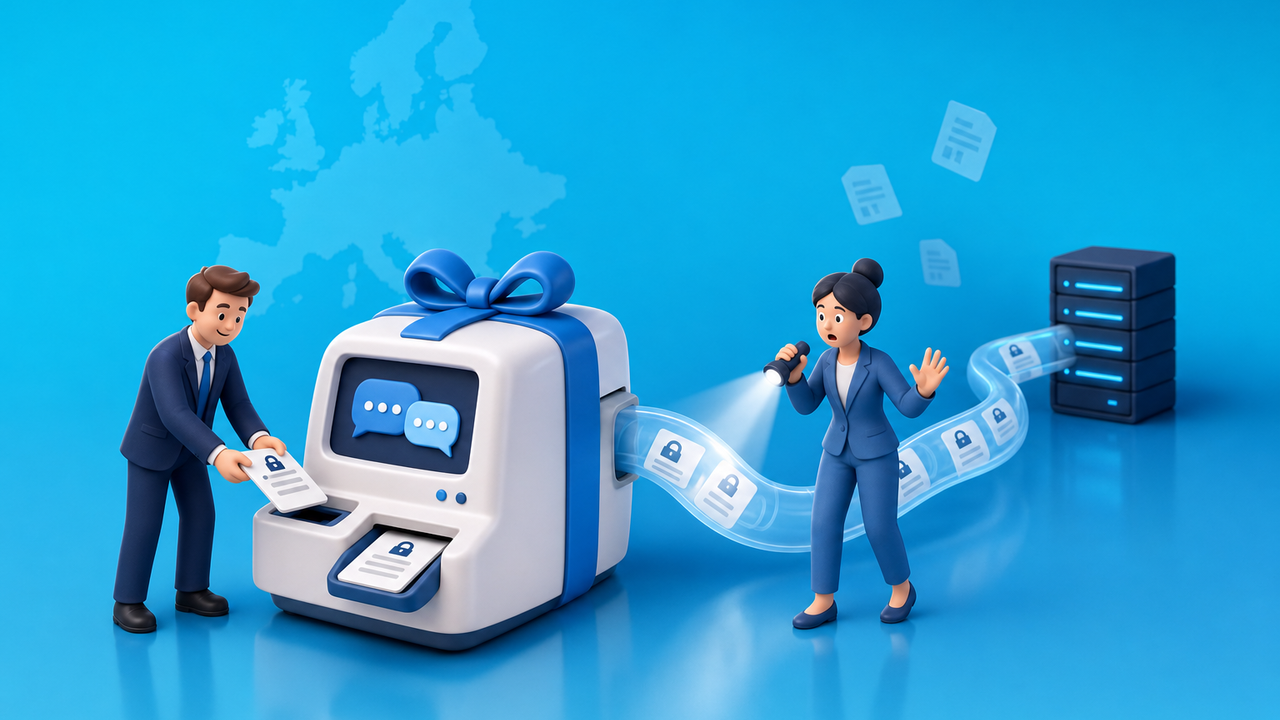
An employee pastes a 40-page supplier contract into a free translator at 4:55 pm, gets clean English in seconds, and logs off. Nobody in legal, IT or compliance ever learns the text left the building. That quiet habit is the heart of the free AI translation tools data risk. This guide shows which setup fits which document, using a red, amber, green rule.
What Is the Hidden Data Risk in Free AI Translation Tools?
The free AI translation tools data risk is the chance that confidential text pasted into a free tool gets stored, reviewed, reused for training or exposed, with no contract, audit trail or control on your side. You pay with your data, and the terms rarely say how long it’s kept.
According to IBM’s Cost of a Data Breach Report 2025, one in five organisations had a breach caused by shadow AI. Organisations with high levels of shadow AI paid an average of $670,000 more per breach than those with little or none.
What Is Free Machine Translation Data Privacy?
Free machine translation data privacy is simply what a no-cost translator does with your input: how long it keeps it, who can read it, and whether it trains future models. Paid plans usually promise deletion and no reuse. Free plans often promise neither, so the plan matters as much as the brand.
Why Does Shadow AI Make Translation the Easiest Leak to Miss?
Shadow AI is any AI tool staff use without approval from IT or security. Translation is easy to miss because it feels harmless: a browser tab, no login, no download.
It’s the newest form of shadow IT. In a TELUS Digital survey of 1,000 large-company US employees published in January 2025, 68% of those who use generative AI at work said they reach public assistants through personal accounts, and 57% admitted entering sensitive information.
What Happens to Your Text in Free AI Translation Tools?
Your text travels to the provider’s servers, where it may be logged, retained, reviewed by staff and, in some free tiers, reused to train models.
Where Does the Data Go After You Click Translate?
It’s sent over the internet to the provider’s servers, processed by a model and sent back to you. A copy may be logged for debugging or abuse monitoring. Retention periods vary, and free tiers rarely guarantee deletion on a schedule you control.
Paid services draw a firmer line. Google says its Cloud Translation API does not use your content for any purpose except providing the service, but the free consumer app has no equivalent contractual guarantee. Microsoft’s Azure Translator documentation says it does not store customer data submitted for translation permanently.
Can Free AI Translators Use Your Documents to Train Their Models?
Some can, depending on the tool and plan. DeepL’s privacy policy says free-version content is used to train and improve its neural networks, while Pro texts are kept only temporarily and not used to improve its services. ChatGPT’s free tier may use conversations to improve models by default unless you opt out in its data controls settings.
What Did the Statoil Case Teach About Indexed Translations?
In 2017, Norwegian broadcaster NRK reported that text typed into Translate.com, including contracts and dismissal letters from Statoil (now Equinor), could be found through Google search. It’s a well-documented case of a free translator exposing corporate documents.
The cause was an older design that made submitted text accessible to volunteer translators, so it doesn’t prove every tool behaves this way today. Still, some documents stayed searchable days after removal requests. Public reports of a comparable leak are scarce in 2025 and 2026, but scarce reporting isn’t safety.
Free Tools vs Custom AI Translation vs On-Premise Machine Translation: Which Protects Your Data?
Free tools give you the least control, paid enterprise APIs add contractual protection, custom AI translation adds domain-trained engines under agreed terms, and on-premise machine translation keeps text inside your own infrastructure. The more sensitive the document, the further along that scale it belongs.
How Do the Four Translation Setups Compare on Data Protection?
The table compares the four setups on the factors auditors ask about. Confirm each entry against the contract you actually sign.
| Factor | Free consumer tool (e.g. DeepL Free) | Paid enterprise API | Custom AI translation | On-premise machine translation |
| Data retention | Unclear, set by provider | Short-term, per contract | Set by agreement | You decide |
| Training reuse | Possible, check terms | Usually excluded by contract | Excluded by agreement (confirm) | None by default; you control any tuning |
| Audit trail | None | Limited vendor logs | Project-level, by agreement | Full, your own logs |
| Data residency | Provider’s choice | Region options | By agreement | Your own servers |
| Data processing or business associate agreement | Rarely | Commonly | Negotiable | Not needed, no outside vendor |
| Cost | Free, paid in data | Per-character usage | Setup plus usage | Highest upfront |
| Best for | Green (public text) | Amber (internal, no personal data) | Amber to red, with human review | Red (privileged, regulated, personal) |
What Is On-Premise Machine Translation and When Is It Worth It?
On-premise machine translation runs the translation engine on servers you control, so text never reaches a third-party cloud. It suits regulated, privileged or classified documents, and contracts that forbid outside processing.
The trade-offs are real, since you host the engine and own its updates and tuning. But you get full logs for auditors and a simple answer to the question of where the text went: it never left your network.
Providers such as Ulatus offer both on-premise machine translation and custom AI translation, describing the first as machine translation deployed within your secure infrastructure.
What Is Custom AI Translation and How Does It Reduce Exposure?
Custom AI translation uses engines trained on your industry or company terminology, delivered under agreed data terms. It cuts exposure because your text goes to a defined, contractually bound environment instead of an anonymous public one.
You negotiate the data terms yourself: retention period, no training reuse and processing location.
The two setups solve different problems. Custom AI translation answers “how good is the output for my terminology, and under what terms?” On-premise machine translation answers “where does the text physically go?” Red documents often need both.
Does Using a Free AI Translator Break GDPR, HIPAA or the EU AI Act?
It can. A free tool isn’t illegal in itself, but sending personal data or protected health information to a vendor without the required contract or safeguards can breach GDPR or HIPAA. The EU AI Act adds transparency duties rather than a ban. Treat this as general information, not legal advice.
How Does GDPR Translation Compliance Work?
Under the General Data Protection Regulation (GDPR), you’re the controller and the translation vendor is a processor. Article 28 requires a written data processing agreement (DPA), and transfers outside the EU need safeguards. Free consumer tools rarely offer that contract, so pasting personal data into one is hard to defend.
When Does Translating Patient or Clinical Text Trigger HIPAA?
Whenever the text contains protected health information and a vendor handles it for a covered entity. That vendor becomes a business associate and must sign a Business Associate Agreement (BAA), unless the data is properly de-identified.
There’s also a quality check on top. Under the Section 1557 final rule (May 2024) and the HHS Office for Civil Rights’ December 2024 guidance, machine-translated critical documents must be reviewed by a qualified human translator as soon as practicable when accuracy is essential.
What Does the EU AI Act Add for Translation Workflows?
Transparency duties, not a ban. Plain translation tools are generally not classed as high-risk, so most translation workflows face disclosure duties rather than the stricter high-risk regime.
Article 50 transparency duties apply from 2 August 2026. And the Digital Omnibus, which entered into force on 27 July 2026 as Regulation (EU) 2026/1744, moves high-risk deadlines to December 2027 and August 2028.
What Do Regulators Fine, and What Does Non-Compliance Cost?
GDPR’s top tier allows fines of up to EUR 20 million or 4% of worldwide annual turnover, whichever is higher. CMS’s 2025 enforcement tracker recorded 2,245 fines totalling about EUR 5.65 billion by March 2025, and IBM’s 2026 report put the global average cost of a data breach at a record $4.99 million.
Which Documents Should Never Go Into Free AI Translation Tools?
Anything you wouldn’t email to a stranger: contracts, privileged legal files, patient records, regulatory submissions, financial results, HR files and M&A material. If a leak would trigger a legal duty, breach a confidentiality clause or move a share price, it needs a controlled workflow.
Why Are Legal Contracts and Privileged Files Off Limits?
Pasting a privileged memo or draft contract into a tool with unclear retention can undermine privilege and breach NDAs, and the exposed Statoil contracts show how such text can surface. Send these to legal translation services working under signed confidentiality terms.
Can Clinical, Patient and Regulatory Text Go Into a Free Tool?
No. Clinical notes, trial documents and regulatory submissions contain personal health data and unreleased product information. Without a BAA or DPA, the tool is a compliance gap, and a mistranslation can harm patients. Use medical translation services with human review inside a secured process.
What About Financial, HR and M&A Material?
Treat all three as red. Merger drafts can move markets, payroll and dismissal files hold personal data, and financial results are often price-sensitive before release.
In PagerDuty and Wakefield Research’s June 2026 survey of 1,250 office professionals in the US, UK, Australia and Japan, 31% said they had shared financial information or confidential company documents with public AI tools.
What Is the Red, Amber, Green Rule for Document Sensitivity?
The red, amber, green rule sorts documents by what a leak would cost. Red is anything privileged, regulated or personal, so use on-premise or custom AI translation with human review. Amber is internal business text without personal data, which belongs in a paid enterprise tool under a DPA. Green is public, non-sensitive text, such as published marketing copy, where a free tool is acceptable.
Why Do Employees Keep Using Free Tools, and Why Do Bans Fail?
Free tools are fast, familiar and need no approval, while the sanctioned route is often slow or missing. Bans alone tend to push use out of sight. In fact, the same PagerDuty survey found 66% of respondents, all non-IT office professionals, used AI tools at work despite believing it was not allowed.
How Big Is the Shadow AI Problem in 2025-2026?
Pretty big. IBM’s 2025 report found 63% of breached organisations had no AI governance policy or were still developing one, and 97% of those with AI-related breaches lacked proper AI access controls. In a July 2026 Kolmogorov Law survey of 500 US adults, only 35.8% said their employer has a clear written policy on sharing work information with AI tools.
How Do You Detect Unsanctioned Translation Tools?
Start with logs you already have. Web proxy and DNS records, browser extension inventories and cloud access reports will show traffic to translation domains. Then ask teams what they use, since anonymous surveys fill in what logs miss.
What Should an Approved Translation Policy Contain?
Name the approved tools, apply the red, amber, green rule, set a response time for the sanctioned option, assign an owner, and spell out what happens when someone breaks the rule. Keep it to one page and offer a fast alternative.
How Do You Vet a Secure AI Translation Provider?
Ask for evidence, not assurances: written answers on retention, training reuse, certifications, data residency, subprocessors, audit logs and deployment options. A provider that commits to all seven in a contract is safer than one with a polished security page.
What Seven Questions Should You Ask Before Signing?
Ask these, and get the answers in writing:
- How long do you retain text?
- Is client data used to train engines?
- Which certifications do you hold?
- Where is data processed?
- Who are your subprocessors?
- Can I see audit logs?
- Can you deploy on-premise or as a custom engine?
As an example, Ulatus states on its data security page that it does not use client data to train its machine translation engines and removes data from temporary storage in real time after processing.
Why Does Human Post-Editing (MTPE) Inside a Secured Workflow Still Matter?
Machine output can be fluent and wrong, and in clinical or legal text one wrong sentence is a liability. Post-editing puts a qualified linguist between the engine and the reader, and security means that linguist works inside controlled, NDA-bound systems. An EMNLP 2025 industry paper on regulated-industry machine translation stresses human-in-the-loop validation.
Ulatus offers hybrid human and AI translation models that pair machine output with trained post-editors.
What Does ISO/IEC 27001 Certification Actually Prove?
It shows an organisation runs an information security management system that’s audited against the standard. It doesn’t prove a breach can’t happen. Treat it as a minimum bar and ask for the certificate scope and numbers. Ulatus lists ISO/IEC 27001:2022 and ISO 17100:2015, among others.
Conclusion: Audit Your Translation Data Flows Before a Regulator Does
Free translators are fine for public text and risky for everything else. That 4:55 pm contract was a red document, so it belonged in an on-premise or custom workflow, with a linguist reviewing the output, not in a browser tab. Give staff a fast approved option, and the quiet habit stops being a quiet liability.
What Three Actions Should You Take This Week?
- Inventory: check logs and ask teams which translators they use.
- Classify: apply the red, amber, green rule to your top five document types.
- Move: route red documents to a secured workflow with human review.
Audit where your teams translate today, then talk to Ulatus about moving red documents to custom AI translation or on-premise machine translation, with human post-editing built in. See also the Ulatus data security practices.