Change “including a component” to “including one component” in a Chinese claim, and you may have just narrowed your patent. That small shift, a plain “a” becoming the numeral “one”, is one the CIPA Journal flagged in 2024, and it shows how patent translation usually goes wrong: quietly. Nobody notices until the claim is tested.
Does AI Replace Patent Translation? The Short Answer
No, AI cannot replace human patent translation for the text that defines your rights. AI can draft patent translations quickly and cheaply, and it’s genuinely useful for reading and searching. But patents remain among the most human-reviewed types of legal translation, because once a patent is filed, the translated words become the legal rights.
Patent translation is the conversion of a patent specification, claims, abstract and related filings from one language into another so that the translated text keeps the exact legal scope of the original. General legal translation aims to convey the meaning and effect of a contract, ruling or statute. Patent translation has to do both jobs at once, staying technically exact and legally precise. That’s why many applicants turn to professional patent translation services staffed by linguists with engineering or science backgrounds.
Slator’s 2025 Legal Services and Language AI Report, as summarised by Big Language Solutions, puts it bluntly: patents get revoked because of words. Legal teams, the summary notes, are increasingly wary of automation bias and want technology paired with human expertise.
Here’s the catch. One patent family contains both the easiest and the hardest legal translation work. The Translation Risk Ladder below ranks documents by what an error costs and whether it can be undone, and it shows where the line between AI and human work actually falls.
What Is Legal Translation, and Why Is Patent Translation Its Highest-Risk Form?
Legal translation is the translation of documents that create, prove or enforce legal rights and obligations, where an error can change the legal outcome. Contracts, court judgments, statutes and regulatory filings all qualify. Providers of legal translation services typically combine language skill with knowledge of the legal systems on both sides.
Patents sit at the top of the risk scale because they’re a legal and technical hybrid. A patent claim is a legal boundary written in engineering language. Get a term wrong and you haven’t just confused a reader. You’ve moved the fence around your property.
Where the translation becomes the law
The path matters. Under the Patent Cooperation Treaty, one international application can lead to protection across roughly 158 contracting states, according to WIPO’s 2026 review. But the PCT isn’t a grant system. After the international phase, which ends 30 months from filing or earliest priority, applicants enter national or regional phases, and many of those require a translation.
That’s the moment a translation stops being a convenience and becomes the operative text. WIPO’s PCT Yearly Review 2026 reports 275,900 PCT applications in 2025, with China filing 73,718 and Japan 47,922. English accounted for 42.6% of publications and Chinese for 24.2%, so a huge share of filings has to cross a language barrier on the way to national protection.
The Translation Risk Ladder: Which Legal Documents AI Handles First
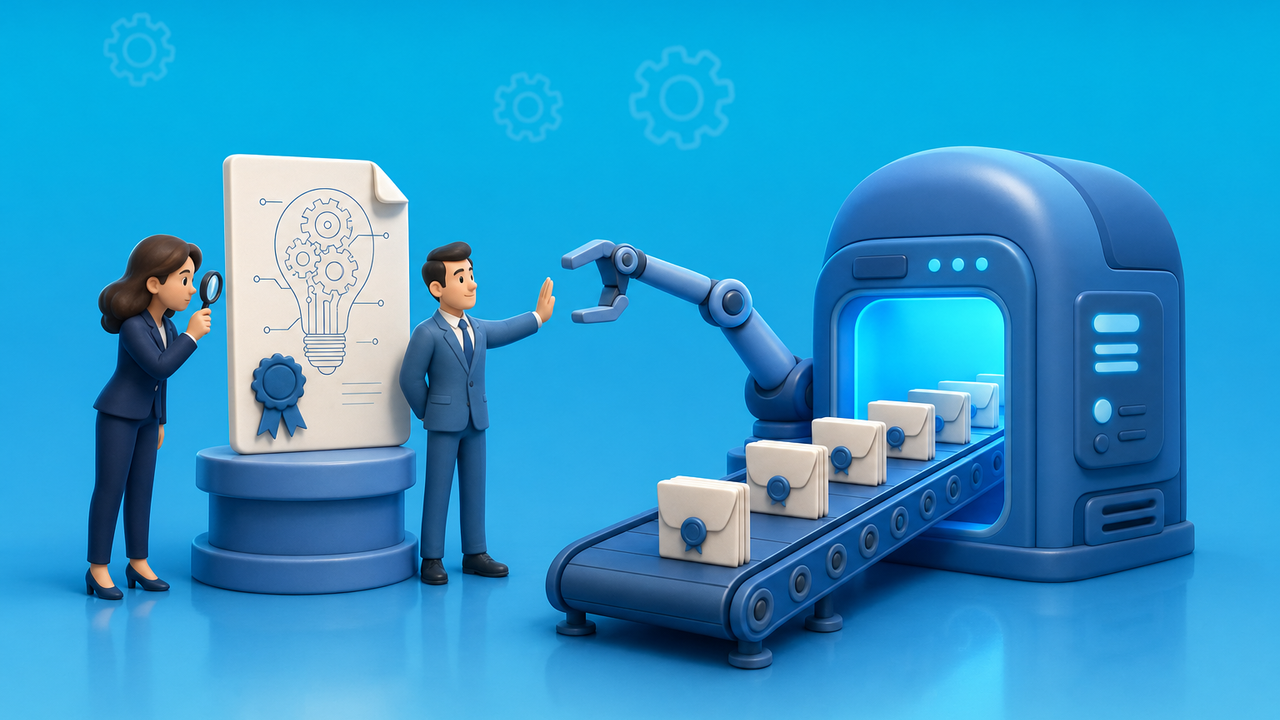
AI handles legal documents best where mistakes are cheap, reversible and read only by the team that ordered the translation. It handles them worst where a mistake becomes public, permanent and enforceable against others. Ranking documents by the consequence of an error gives four tiers.
| Tier | Document types | Consequence of error | Reversible? | Typical AI role |
| 1 | Prior art screening, office action review, internal due diligence | Low: used for understanding only | Yes | Raw AI, light review |
| 2 | Contracts, NDAs, correspondence | Moderate: disputes, but parties can renegotiate | Mostly | AI draft plus human post-editing |
| 3 | Court filings, regulatory submissions | High: rulings and approvals depend on the text | Partly | Human-led, AI-assisted |
| 4 | Granted claims, filing specifications | Very high: defines scope, invalidity risk | Rarely | Expert human translation plus independent review |
Each tier boils down to two questions: how much does an error cost, and can you undo it?
Tier 1: low-stakes, high-volume
Say you’re screening 400 foreign-language patents to find the five that matter. Raw machine output is fine here. You only need the gist, and nobody will enforce your reading of the document.
Tier 2: contracts, NDAs and correspondence
A mistranslated clause in a contract or NDA can start a dispute, but the parties know each other and can usually clarify or renegotiate. Adoption is already high. A 2025 DeepL survey of 1,000 US legal professionals found that 96% use AI at work and 49% use general-purpose AI tools for legal translation, while 38% admit unapproved use. The survey was vendor-commissioned, so read it as a sign of adoption, not a verdict on trust.
Tier 3: court filings and regulatory submissions
In a court filing, a wrong word can weaken an argument that a judge, not your counterparty, will read. In a regulatory submission, it can stall an approval. Those errors are only partly reversible, and fixing them costs time and credibility. A pharmaceutical dossier, for instance, depends on precise terminology, and specialist providers of life sciences and medical translation build review steps around exactly that. Get it wrong and you could lose your shot at market approval entirely.
Tier 4: granted claims and filing specifications
Granted claims and filing specifications need a qualified human translator plus an independent second review, because the translation becomes the operative text and is rarely reversible. Unlike a contract, a claim term is read by examiners, competitors and judges who were never part of your conversation. Even institutional translators are careful here: a 2025 paper in Translation Spaces found they use machine translation suggestions more cautiously for legal texts.
And here’s the twist. A single patent family spans the whole ladder. Searching prior art is Tier 1, reviewing an office action is Tier 1 or 2, and translating the claims for national phase entry is Tier 4. Patents are both the most AI-friendly and the least AI-friendly legal work, depending on which page you’re holding.
Five Structural Reasons Patents Resist AI Longer Than Contracts or Court Filings
Patents resist AI because five structural features of patent law make errors costly, hard to repair and hard to detect. They’re about what the text does once it exists, not about raw translation quality.
- Claims are operative law. A claim sets the scope of protection, so one word can widen or narrow it. In the CIPA Journal’s example, “a component” became “one component” in Chinese, which risks limiting the claim to just one component. A contract typo can be settled with a phone call, but a claim term is read by people who owe you nothing.
- Errors are hard to fix after filing or grant. Most patent systems restrict adding new matter, so you can’t “improve” a translation later with content that wasn’t in the original. Under EPC Article 70(1), the text in the language of the proceedings is authentic before the EPO and in every contracting state. But Article 70(3) lets a state treat its own-language translation as authentic when it gives narrower protection than the original, except in revocation proceedings. In other words, a translation that narrows your claims can bind you. States that adopt that rule must permit corrected translations, but only under further conditions.
- Claim syntax is unforgiving. A claim is usually one long sentence, packed with antecedent references (“said valve” must point back to an earlier “a valve”). The difference between “comprising” (open-ended) and “consisting of” (closed) changes what infringes. A peer-reviewed 2025 MT Summit paper by Azami and colleagues found that a fine-tuned LLM beat standard baselines on BLEU and COMET and cut omissions and repetitions. But it also produced hallucination errors that traditional models didn’t.
- Inventors coin new terms. A truly novel invention often needs a word no training data has seen. A model will guess, and a guess is the last thing you want in a claim. The 2025 Workshop on Asian Translation ran the first shared task on patent claims translation, and its organisers note that terminology use and consistency are still hard to evaluate automatically.
- Confidentiality can threaten novelty. The EPO applies absolute novelty, so an applicant’s own disclosure before filing can be cited against the application. A June 2026 client alert from the law firm Stites & Harbison warns that entering invention details into an external public AI tool may amount to public disclosure, and that even enterprise AI products need a contract review because data handling varies. It’s a risk assessment, not settled law, but few inventors want to test it.
Where AI Does Work in Patent Translation Today
AI works well in patent workflows wherever the output is read, not relied on as the legal text. That includes searching foreign-language prior art, triaging documents, reviewing office actions and producing information-only translations for litigation teams. Used this way, machine translation saves days and costs very little.
Patent-trained engines versus general LLMs
Questel says it has used patent-trained neural engines (DNMT) since 2018, and claims they surpass current general-purpose LLMs on patent applications. That’s a vendor claim with no independent benchmark behind it, and the 2025 MT Summit result points the other way, since a fine-tuned LLM scored well. Both approaches are improving, and neither has earned unsupervised trust on claims.
Questel also sells tiers, from AI Auto up to Premium Filing Ready, with routine material leaning on AI and high-value filings getting more human attention. Basically, it’s the risk ladder in commercial form.
Adoption and the patent offices themselves
Nimdzi reported in May 2025 that average adoption of post-editing among language providers rose from 26% in 2022 to about 46% in 2024. That’s general industry data, not patent-specific, but it suggests machine translation with human post-editing is now the default model rather than the exception.
Patent offices are paying attention too. Japan’s patent office added a section on non-literal translations to its Examination Handbook on May 29, 2025, a reminder that word-for-word output isn’t always the goal.
Japanese and Chinese Patent Translation: Where AI Struggles Most
Japanese-to-English and Chinese-to-English claims are a particularly hard case for AI, because the source languages leave out information that English claims must state. And this isn’t a niche problem. China and Japan are among the largest PCT filers, and Korea added 25,016 applications in 2025, according to WIPO (2026).
No spaces, ambiguous subjects and long compound claims
Japanese and Chinese are written without spaces between words, so segmentation comes first. Subjects are routinely dropped, which leaves the translator to infer who does what, and claims tend to run on as long compound sentences. A model that infers the wrong subject produces fluent English with the wrong scope.
Technical term variants and number traps
Neither language marks singular and plural the way English does, so “a component” and “components” can collapse into one term, the CIPA Journal explains. It also notes that “at least one component” can risk rejection in China unless the description addresses an upper limit. And “bicycle” implies two wheels in English, an implication that Japanese 自転車 and Chinese 自行车 don’t carry.
Why language pair matters when choosing a workflow
For Japanese and Chinese claims, a reviewer has to read the source claim, not just polish the English. A monolingual editor will never see what the machine dropped. A workflow that works for German-to-English may not transfer, so for Japanese to English translation and Chinese to English translation, insist on bilingual review. Rules for correcting errors also vary by office, so check with local counsel.
How to Choose a Workflow: A Decision Guide by Document and Risk
Match the workflow to the tier: raw AI for Tier 1, post-editing for Tier 2, and full human translation with independent review for Tiers 3 and 4. Slator’s 2025 Language Industry Market Report describes delivery models as fully automated, expert-in-the-loop and human-led, which maps neatly onto this approach.
Five questions to ask a translation provider
- Who translates the claims? Look for a linguist with subject-matter training, not a generalist.
- Is there a second, independent review against the source? One pass isn’t enough for a claim.
- Where does my unpublished invention go? Ask for data-handling, retention and confidentiality terms in writing.
- Which engines are used, and for what? A provider should say where AI is applied and where it isn’t.
- What happens if an error is found after filing? Look for a documented correction process and liability terms.
Red flags in AI-only patent translation offers
Walk away from any provider that promises “100% accuracy” from software alone. Be wary of turnaround times that leave no room for review, vague answers about data handling, cost-saving claims without current, documented numbers, and pricing far below human rates for claim text. And if a tool offers a quality score instead of a named reviewer, ask who’s accountable when the claim is challenged.
Will the Resistance Last? What Would Have to Change
The resistance will last until the legal system trusts machine output as much as it trusts a named human, and in our view that’s a long way off. Four conditions would loosen the human-review requirement.
- Legal acceptance of machine-certified translations. Courts and offices would need to treat them as reliable evidence of scope.
- Verifiable claim-scope checking. Today’s evaluation struggles with terminology drift and hallucination, as the 2025 research shows. A tool that proves a translation preserves scope would change the equation.
- Secure private models. Inventors need confidence that unpublished text never leaves a controlled environment.
- Clear allocation of liability. Someone has to carry the loss when a claim is narrowed, and software vendors rarely accept that today.
How the translator’s role will change
We expect translators to spend less time on first drafts and more time as claim-scope reviewers, doing more checking, more terminology control, and more advising on which tier a document belongs in.
Conclusion: Use AI Where Errors Are Cheap, Humans Where Words Become Rights
Use AI for search, triage and information-only reading, and keep expert humans on claims and filing specifications. Patents resist AI longer than other legal documents because their translations are the operative text, are hard to correct, and are written in some of the most unforgiving syntax in legal writing. One extra “one” in a Chinese claim is all it takes.
Before your next national-phase filing, send your claims for review by a patent-specialist linguist, and ask for a free sample or quote for patent translation from Ulatus.